The ultimate guide on building sustainable, long-term wealth through the proven mechanics of compound interest. Whether you are taking your very first steps into personal finance, planning for retirement, or looking to optimize your monthly savings strategy, understanding how your money can grow exponentially over time is the single most important skill you can acquire.
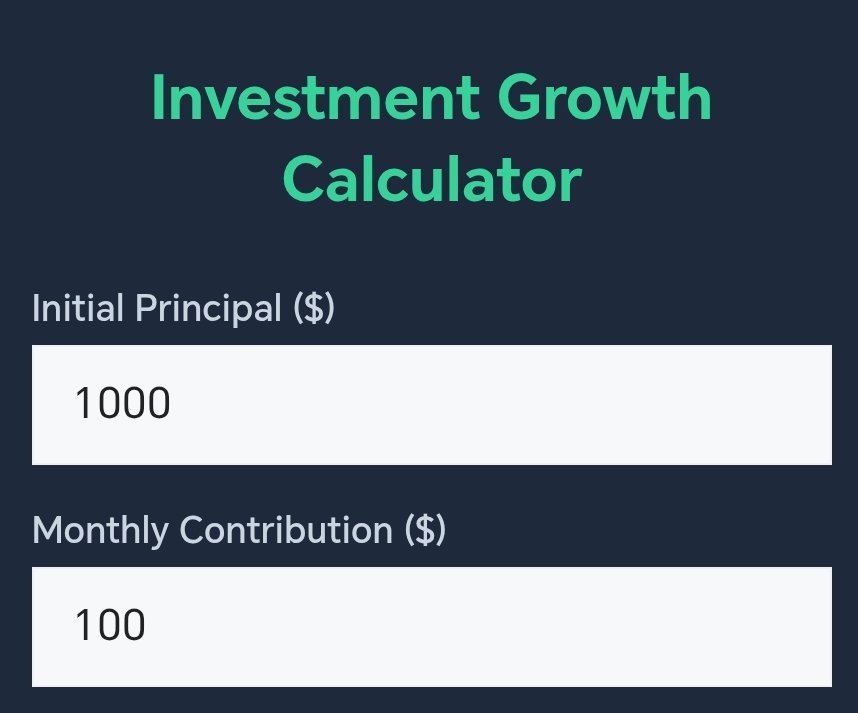
To help you visualize your financial future, use the Investment Growth Calculator embedded on this page to test different scenarios, adjust your monthly contributions, and see how compounding works in real-time. Below, we break down the core principles of compound growth, how to use the calculator effectively, and practical strategies to accelerate your journey to financial independence.
What Is Compound Interest and Why Is It Called the “Eighth Wonder”?
Investment Growth Calculator
Albert Einstein famously (and perhaps apocryphally) referred to compound interest as the eighth wonder of the world, noting that "he who understands it, earns it... he who doesn't... pays it."
In simple terms, compound interest is interest calculated on the initial principal plus all of the accumulated interest from previous periods. Unlike simple interest, which only pays returns on your original starting amount, compound interest creates a snowball effect.
- Simple Growth: Your money grows in a straight, linear fashion because you earn the exact same dollar amount every single year based solely on your starting balance.
- Compound Growth: Your money grows in an exponential curve. As your balance increases, the amount of interest you generate each month or year grows larger, even if you never add another cent of your own money.
The secret ingredient that transforms compound interest from a neat math trick into a life-changing wealth tool is time. The longer your money stays invested, the steeper and more powerful the exponential curve becomes.
The Four Pillars of Exponential Investment Growth
When you plug numbers into an investment growth calculator, you are interacting with four core variables. Mastering how each one influences your final balance can completely change your savings trajectory:
1. Initial Principal
This is your starting lump sum—the cash you deposit on day one. While a larger starting principal gives your portfolio an immediate head start, it is not strictly necessary to become wealthy. Thanks to compounding, consistent small contributions often outperform a one-time large deposit left stagnant.
2. Regular Monthly Contributions
Consistency beats perfection. By setting aside a fixed amount every month (such as $100, $200, or $500), you benefit from dollar-cost averaging while continuously feeding the compounding engine. Every monthly contribution immediately starts generating its own returns.
3. Annual Interest Rate (Rate of Return)
Your interest rate represents the expected annual percentage yield (APY) or market return generated by your assets (such as broad-market index funds, dividend stocks, or high-yield savings instruments). Historically, diversified equity markets have averaged around 7% to 10% annually over long multi-decade horizons (adjusted loosely for inflation).
4. Time Horizon (The Multiplier)
Time is infinitely more powerful than the interest rate. Leaving your money invested for 30 years instead of 10 years doesn't just triple your results—it can multiply them tenfold due to the steep slope of the exponential curve in its later stages.
How to Use the Investment Growth Calculator
Our interactive calculator is designed to be straightforward and fast. Here is how to make the most of it:
- Enter Your Initial Principal: Input whatever starting savings or capital you currently have set aside. If you are starting from zero, simply enter $0.
- Set Your Monthly Contribution: Determine a realistic amount you can comfortably save and invest each month without straining your lifestyle budget.
- Estimate a Realistic Interest Rate: Input your expected annual return. For conservative projections, use 5%–6%; for stock market index fund tracking, 8%–10% is commonly used in educational modeling.
- Choose Your Time Horizon: Select how many years you plan to let your investments compound.
Once you hit Calculate Growth, the tool instantly breaks down your Total Principal Contributed, your Total Interest Earned, and your Final Portfolio Balance.
Case Study: The Power of Starting Early
Consider two hypothetical investors, Investor A and Investor B:
- Investor A starts investing $200 every month at age 25 and stops entirely at age 35 (contributing for 10 years, totaling $24,000). They then let that money sit untouched until age 65.
- Investor B waits until age 35 to start, but invests $200 every single month all the way until age 65 (contributing for 30 years, totaling $72,000).
Assuming an annual return of 8% compounded monthly, Investor A—despite investing three times less total money out of pocket—will often end up with a significantly larger or comparable nest egg by age 65 simply because their money had an extra decade to compound. This real-world phenomenon highlights why the best time to start investing was yesterday; the second best time is today.
Frequently Asked Questions (FAQs)
Does this calculator account for inflation?
Standard compound interest calculators project nominal growth. To calculate real purchasing power, it is wise to subtract roughly 2% to 3% from your nominal annual interest rate to account for long-term inflation.
How often is interest compounded in this tool?
This calculator compounds interest on a monthly basis, mirroring how most modern investment platforms, mutual funds, and high-yield savings accounts calculate and credit earnings.
Is investing risk-free?
No. All market investments carry inherent risks, and historical returns do not guarantee future performance. Always evaluate your risk tolerance and diversify your portfolio.
Disclaimer: The information and calculations provided on this page are for educational and informational purposes only and do not constitute professional financial, tax, or investment advice. Always perform your own due diligence or consult with a licensed financial advisor before making major financial decisions.