
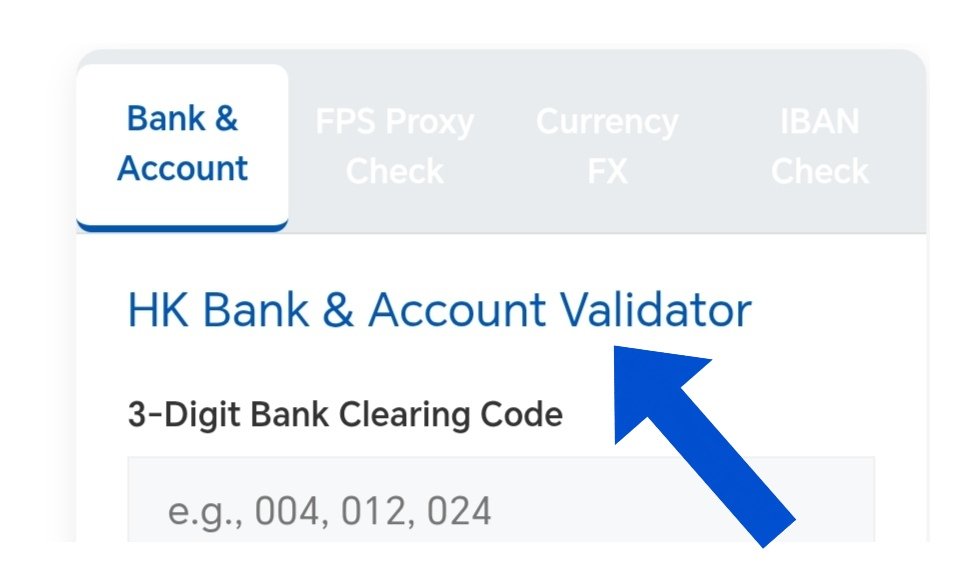
HK Bank & Account Validator
FPS Proxy Identifier Validator
HKD Multi-Currency Converter
International IBAN Validator (ISO 13616)
Building a browser-based financial utility suite around Hong Kong clearing codes, Faster Payment System (FPS) proxies, currency conversion, and International Bank Account Number (IBAN) checksum verification requires careful attention to how regional payment rails actually work. Unlike European markets that rely on standardized IBAN strings for routine domestic and cross-border transfers, Hong Kong banking combines three-digit interbank clearing codes, institution-specific local account structures, SWIFT/BIC codes, and FPS addressing proxies.
This guide documents how each component of the toolkit operates, explains the edge cases and regional nuances behind the validation rules, and outlines how to extend the single-file prototype into a more resilient web application.
1. Hong Kong Clearing Codes and Local Account Structure
Hong Kong Interbank Clearing Limited (HKICL) manages core payment clearing infrastructure in Hong Kong, including the real-time gross settlement systems and FPS. Retail and commercial banks operating in Hong Kong are assigned three-digit clearing codes (often formatted with leading zeros, such as 003, 004, 012, or 024, alongside virtual bank codes such as 387, 390, and 391).
Why Leading Zeros Matter
Users frequently type numeric codes without leading zeros—for example entering 4 instead of 004 or 24 instead of 024. Normalizing input with padStart(3, ‘0’) after trimming whitespace prevents false misses on single- or double-digit clearing codes. However, strict input validation should still reject non-numeric characters or strings longer than three digits so unintended text does not silently pad into a valid-looking code.
Local Account Number Variations
While a standalone HTML validator can check general digit length and strip common visual separators such as hyphens (-) and spaces, Hong Kong banks do not enforce a single uniform account length across every product or institution:
- Common retail lengths: Many Hong Kong checking, savings, and multi-currency accounts fall within a 9- to 12-digit window once dashes are removed.
- Branch vs. account segments: In many local formats, the first three digits represent a branch code while the remaining digits identify the specific account and currency or sub-account suffix. Treating the first three digits as a branch prefix is helpful for display formatting, but developers should treat it as an illustrative structural breakdown rather than a guaranteed bank-wide rule.
- Check digits: Individual banks use proprietary check-digit algorithms on full account numbers. A front-end script without a bank-specific check-digit table can verify formatting and length, but it cannot guarantee that an account number actually exists or belongs to the intended recipient.
2. Faster Payment System (FPS) Proxy Identifiers
Launched by HKICL in 2018, the Faster Payment System enables near-real-time fund transfers in Hong Kong dollars and renminbi across participating banks and stored value facilities. Instead of requiring a recipient to share a full bank code and account number every time, FPS allows users to link accounts to proxy identifiers.
Supported Proxy Types
A practical FPS format checker needs to distinguish among the primary proxy categories users enter in payment forms:
- System-generated FPS IDs: Numeric identifiers issued when a user registers an FPS profile, commonly appearing as 7- or 9-digit numbers depending on registration channel and system rules.
- Hong Kong mobile numbers: Eight-digit local subscriber numbers in Hong Kong, often preceded by the country calling code +852 or 852 when pasted from contact lists or international forms. Stripping spaces, hyphens, and parentheses before matching helps catch common copy-paste variations.
- Email addresses: Standard email addresses registered as payment proxies. Basic pattern matching confirms structural syntax (a local part, an @ symbol, and a domain with a dot), though email syntax validation alone cannot confirm whether the address is registered and active on FPS.
Format Validation vs. Live Directory Lookup
A client-side validator in pure HTML and JavaScript only checks syntax and format. Even if an input matches a valid 8-digit Hong Kong mobile number or a properly structured email address, that identifier might not be bound to an FPS account, might be restricted to specific currencies, or might belong to an unverified profile. In production banking workflows, format checks serve as an immediate UX guard before submitting a request to an authorized payment API or bank portal.
3. Currency Conversion and Pegged Exchange Mechanics
A currency converter included in a Hong Kong and regional finance toolkit typically centers on the Hong Kong dollar (HKD), alongside regional and major global currencies such as USD, CNY, MOP, EUR, GBP, and JPY.
Linked Exchange Rate Context
The Hong Kong dollar operates under Hong Kong’s Linked Exchange Rate System, which maintains a target trading band around 7.80 HKD per 1 USD (specifically 7.75 to 7.85 under the Convertibility Undertakings managed by the Hong Kong Monetary Authority). Nearby regional currencies—such as the Macanese pataca (MOP), which is also pegged to HKD—and floating currencies like CNY, EUR, GBP, and JPY behave differently:
- Pegged/managed pairs: HKD/USD and MOP/HKD exhibit narrow trading ranges relative to floating fiat currencies, though spot rates still fluctuate daily within permitted bands.
- Floating pairs: Currencies such as EUR, GBP, and JPY float more freely against USD and HKD, meaning static hardcoded rates drift over time.
Static Rates vs. Live Market Feeds
Hardcoding exchange rates inside a client-side script makes a tool work offline and load instantaneously, which is useful for quick estimates or demonstrations. However, static rates become stale as market prices move. For real financial calculations, invoices, or treasury planning, you should fetch live rates from a reliable foreign exchange API, cache responses briefly to avoid rate limits, and clearly display the rate timestamp and whether the quote is indicative or mid-market. Floating-point arithmetic in JavaScript (parseFloat, division, and multiplication) can also introduce tiny binary rounding artifacts on decimal currency amounts, so formatting output cleanly with Intl.NumberFormat and rounding display precision appropriately is essential.
4. IBAN Checksum Validation (ISO 13616) and Hong Kong’s Position
The International Bank Account Number (IBAN) standard (ISO 13616) is widely used across Europe, the Middle East, and parts of the Caribbean and Americas to standardize cross-border account identification and catch transcription errors using a Modulo-97 check digit calculation.
Why Hong Kong Does Not Use IBANs
A frequent point of confusion for international senders paying a Hong Kong bank is searching for a “Hong Kong IBAN.” Hong Kong does not use IBANs. International transfers to a Hong Kong bank account normally require:
- The recipient bank’s SWIFT/BIC code (typically 8 or 11 alphanumeric characters identifying the institution, country, location, and optional branch).
- The recipient’s local bank account number (and sometimes the bank name, branch details, and recipient address depending on the payment corridor).
Flagging HK-prefixed inputs immediately prevents users from wasting time trying to force a local Hong Kong account into an IBAN checksum validator.
How the Modulo-97 Algorithm Works
For countries that do use IBANs—such as the United Kingdom (GB), Germany (DE), or France (FR)—the validation routine follows a deterministic sequence:
- Normalize formatting: Remove whitespace and convert lowercase letters to uppercase.
- Check structure: Verify that the string starts with a two-letter ISO country code, followed by two check digits, followed by the Basic Bank Account Number (BBAN) within the allowed length range.
- Rearrange characters: Move the first four characters (country code and two check digits) to the end of the string.
- Convert letters to numbers: Replace each alphabetic character A through Z with its two-digit numeric equivalent (A = 10, B = 11, …, Z = 35).
- Compute remainder mod 97: Because the resulting numeric string can be 30+ digits long—exceeding JavaScript’s safe integer precision (Number.MAX_SAFE_INTEGER)—processing digit by digit with (remainder * 10 + digit) % 97 avoids overflow errors. A valid IBAN produces a final remainder of 1.
Note that Modulo-97 confirms mathematical check-digit integrity and basic character structure, not country-specific BBAN length rules (each IBAN country has a fixed total length) or account ownership.
5. Extending the Toolkit Safely
If you plan to expand this single-file prototype into a broader web application or team utility, several engineering upgrades will improve reliability and maintainability:
- Separate data from UI logic: Move bank clearing tables, SWIFT codes, and exchange rate configuration into structured modules or external JSON/API sources so adding new institutions or currencies does not require editing DOM strings.
- Tighten input and state handling: Avoid relying on implicit global event objects inside inline onclick handlers; pass explicit references or attach addEventListener handlers cleanly in JavaScript.
- Add clear disclaimers: Because client-side format validators and indicative exchange rates do not perform live bank directory lookups or execute regulated payments, clearly label outputs as format/indicative checks rather than official payment confirmation.
- Support keyboard and copy workflows: Adding Enter-key submission on inputs and one-click copy buttons for formatted codes or converted amounts makes everyday lookups faster without cluttering the interface.